The 15.5% Illusion: The Real Math Behind Airbnb Fees in 2026

The short-term rental landscape has spent the past year absorbing a structural change served up by the industry’s dominant OTA. Airbnb has been migrating hosts onto a mandatory 15.5% host-only fee in waves. PMS-connected hosts were moved automatically between October 2025 and April 2026, and remaining hosts are scheduled to be converted by September 15, 2026 (October 13 for EU hosts). This shift eliminates the legacy split-fee model entirely, whereby Airbnb used to charge a separate guest service fee in parallel with the accommodations charge, cleaning fees, etc.
While Airbnb touts this change as a win for transparent checkout pricing, hosts have slowly come to realize that the math is clearly not in their favor. It’s plausible that eliminating surprise fees at checkout will reduce cart abandonment and result in increased booking velocity across the entire Airbnb platform. But it’s also likely that most hosts will experience further margin compression, due to higher taxation and a misconception about how to properly adjust underlying nightly rates to account for Airbnb’s new structure.
If the challenges of the past couple of years have taught us anything, it’s that short-term rental investing is a margin business. Ignore the math at your own peril. And when a platform you rely on for marketing and distribution restructures how it extracts its revenue, your pricing strategy will need to adjust. Airbnb’s shift to a host-only fee structure isn’t merely a cosmetic update to the checkout screen. It’s something of a Trojan horse silently rewiring your unit economics. If you don’t adjust your pricing with mathematical precision, you’ll end up worse off than you were before the update.
The “Simple” Fee That Actually Costs You 18.35%
When Airbnb initially announced this update, a lot of hosts assumed the math was linear and simply raised their nightly rates by 15.5% to compensate for the new structure. Newsflash: That math doesn’t work!
You are raising your net rate but Airbnb will (of course) be charging 15.5% on the gross, because it juices their commission. Because the platform deducts its cut from the new higher total, a 15.5% markup leaves you short every time. Here’s the actual arithmetic.
If your target is to net $100, and you mark up your rate to $115.50, Airbnb takes 15.5% of that new gross figure = $17.90. You walk away with $97.60. You’ve lost $3.40 of margin on a booking you thought you protected.
To actually clear your original target, you need to mark up your listed rate by 18.35%, which necessitates doing the math like this: Target Payout ÷ 0.845.
Divide your $100 target by 0.845 and you get $118.34. When Airbnb takes 15.5% of $118.34, they extract $18.34 and your net deposit is exactly $100. If you’re looking to re-calibrate your Airbnb rates in 2026, that’s the correct way to do it to avoid unexpected payout shortfalls.
Unfortunately, these adjustments aren’t limited to your nightly rate. Airbnb applies their 15.5% cut to your entire booking subtotal, including pass-through operational costs like cleaning fees, extra person fees, etc.
Pass-through fees no longer offer a safe harbor from the almighty commission sword. Under the new host-only fee model, every dollar processed through the OTA is subject to the platform commission save for taxes (which are discussed in detail below). As a result, you’ll also need to mark up your pass-through fees by 18.35% and get comfortable with the idea that, conceptually, Airbnb will now make a commission on your cleaning fee.
Case Study: The Anatomy of a $5,000 Maui Booking
Theoretical math is one thing. Real-world cash flow is another. In this example, we break down a 14-night Airbnb reservation at Wailea Oasis, a 2BR/2BA vacation rental condo that I self-manage on Maui. Through this example, you’ll see precisely how the new 15.5% fee structure impacts operational margins in practice.
Host-Entered Charges:
- Rent: $4,246.80 ($303.34/nt)
- Cleaning Fee Charge: $267.50 ($19.11/nt)
- Booking Subtotal: $4,514.30 ($322.45/nt)
The Tax Burden:
- Maui GET (4.712%): $212.71
- Maui TAT (14%): $632.00
- Total Guest Payment: $5,359.01
At checkout, the guest paid $5,359.01 and saw only the following line items:
- 14 nights x $322.45 = $4,514.30
- Taxes = $844.71
- Total (USD) = $5,359.01
And then here’s how my actual host payout will flow…
Airbnb applies its 15.5% host-only fee against the booking subtotal of $4,514.30, deducting $699.72. My net payout (after reserving for taxes which I remit directly) drops to $3,814.58, which is roughly 71% of the total amount paid by the guest. Looking at it from the guest’s perspective, commissions and occupancy taxes are increasing the overall guest-paid cost of the reservation by $1,544.43, which is an increase of more than 40%.
Now look at the turnover costs. I charged the guest a $267.50 cleaning fee. Airbnb took 15.5% of that line item too, which amounts to $41.46. I netted only $226.04 for cleaning, while the actual cost is $300 per turn (yes, Hawaii is expensive!). Because I hadn’t marked up the pass-through cleaning fee by 18.35% (which would be $355.05), I absorbed a $73.96 loss on my cleaning pass-through. That makes it more of a “partial recovery” than a true pass-through. But if I mark up the cleaning fee to adjust for this, my rates start to look too high on shorter stays since Airbnb is now blending fees into the rent line instead of calling them out separately. Yes, this is just optics, but optics do matter.
Remarkably, the bad news just keeps coming. The tax math can add yet another layer of financial pain for hosts.
Hawaii applies its General Excise Tax (GET) and Transient Accommodations Tax (TAT) against the gross booking subtotal. As of 2026, the state TAT is 11%, and Maui’s county surcharge adds another 3%, for a combined 14% TAT. Add the 4.712% GET, and the total occupancy tax burden on this Wailea Oasis condo is 18.712%.
Don’t even get me started about property taxes! That’s another post entirely.
While the occupancy tax percentage doesn’t change with Airbnb’s new commission scheme, the amount of taxable revenue goes up, thereby handing local tax authorities a surprise windfall. Here’s why…
Airbnb was not previously liable for TAT on their service fees. Hawaii’s TAT is structured to apply only to operators (hosts), not booking platforms, and Airbnb doesn’t collect or remit TAT on hosts’ behalf in Hawaii. Under the old split-fee model, the Airbnb guest-side service fee simply sat outside the taxable base entirely and wasn’t subject to TAT. It was only subject to Hawaii’s General Excise Tax (GET) when Airbnb corporate booked it as revenue on their side of the ledger.
Now that Airbnb’s commission dollars are folded into the nightly rate instead of being a separate platform charge, it appears that these dollars become part of the gross rental proceeds. Hawaii’s TAT regulation treats a platform’s withheld commission as a non-deductible cost, so Airbnb now collects TAT from the guest on Airbnb’s commission, which they did not previously do on their “service fees.” This inflates the tax burden on the guest, thereby putting even more downward pressure on your rates, as guests do indeed compare the all-in cost against competing hotels and other OTAs.
Applying the 18.712% combined tax rate to the $699.72 Airbnb commission means $130.93 in net new lodging taxes was generated for this booking alone, purely as a result of Airbnb changing their commission structure. Airbnb essentially created a new tax burden that theoretically will increase the total cost of many bookings across their platform. Why?
Strangely, there’s yet another tax layer in play here related to Hawaii’s somewhat unique general excise tax (GET). Hawaii’s GET isn’t a single-stage sales tax with a resale exemption like most states. It’s a recurring pyramid tax, which means every business in a transaction chain owes GET on its own gross income, with no credit for GET already paid upstream or downstream on the same dollars. You owe GET on your full gross rental proceeds, commission included, per the regulation above.
Separately, under Hawaii’s marketplace facilitator law, any facilitator with Hawaii-sourced gross income over $100,000 or 200+ transactions (a threshold Airbnb clears many times over) is required to register and pay its own GET on that Hawaii-sourced income, which of course includes its commission revenue. That means Airbnb’s $699.72 commission take (from the example above) likely gets hit with GET twice: once as part of my gross rental income and then again as Airbnb’s own gross income, with no offset or deduction for either of us. It simply raises prices for our guests while enriching local tax authorities.
This is how Hawaii’s GET is designed to work. It’s not a loophole or an error, it’s just yet another way Airbnb’s pursuit of increased profitability is raising costs for travelers while simultaneously squeezing margins for hosts. To be fair, even Airbnb’s old 3% host fee sat inside this same double-taxed GET bucket. What’s new is the scale of today’s GET double-taxation at 15.5%, which means roughly five times more commission is now subject to the “Taxes” line item calculation at the moment of booking.
So, circling back to the question we asked earlier, why would Airbnb voluntarily route more tax revenue toward the exact municipalities that have spent the last several years restricting short-term rentals, capping permits, and updating local zoning to phase out vacation rental activities? I can only presume that they figure this is a necessary cost of pursuing a structural change that will in the long-run serve to increase their overall profitability. The inconvenient fact that it leaves both hosts and guests worse off doesn’t seem to be much of a deterrent.
The Hidden Tax Trap: Paying TOT on Airbnb’s Commission
The prior real-world example points to a systemic issue that may impact host profitability worldwide. Many local, state, and even national governments calculate all sorts of income taxes and Transient Occupancy Taxes (TOT) based on the gross amount paid by the guest.
Before the fee shift, the guest service fee was charged by Airbnb directly to the traveler. As discussed, it was often mathematically isolated and not always part of your gross rental revenue.
By folding the 15.5% commission into your upfront nightly rate, Airbnb inflates your top-line gross revenue. The guest is no longer just paying the platform for convenience on the side. Instead they’re paying a higher amount specifically for “accommodations” and you’re now paying municipal taxes on Airbnb’s commission revenue. This compounding effect quietly moves cash to local tax authorities, inflates your 1099-K reporting, and erodes net operating income if you don’t make substantial adjustments.
For example, if your property grosses $100,000 a year under the new structure, $15,500 of that belongs to Airbnb. But your local tax jurisdiction may tax you on the full $100,000, not the $84,500 of revenue that would have resulted under Airbnb’s old “service fee” structure. At a 14% TOT rate, you’re now remitting $2,170 in taxes on dollars that never hit your bank account. That’s not cool!
Check your local tax ordinances. If your municipality assesses TOT on gross receipts rather than net host payouts, this structural change just handed you (and/or your guests) a hidden tax increase. And it’s easy to miss unless you’re tracing every dollar back to the source.
A note on this section: Hawaii’s TAT regulation (HAR §18-237D-1-03) treats a commission taken from a host’s own listed rate as non-deductible, whether withheld before payout or billed as a separate add-on. Airbnb’s old guest-side service fee was different. It was not a cut of the host’s rate, but a separate charge Airbnb billed and kept, which is why it fell outside taxable gross rental. Tax treatment of platform commissions varies by state and county, so hosts should confirm specifics with a CPA familiar with local TOT/TAT rules before relying on this information.
“OTA Leakage” Compared: Working Backward from Total Guest Spend
To accurately compare distribution channels, we always look past the headline percentages platforms advertise and measure what we call “OTA Leakage,” which is the absolute dollar difference between what leaves the guest’s credit card (excluding taxes) and what lands in your bank account.
If a guest has exactly $1,000 to spend on a vacation, how much of that is lost to platform friction before the deposit hits your bank account?
The $1,000 Guest Spend Breakdown
| Channel | Total Guest Spend (Pre-Tax) | Guest Service Fee Deducted | Listed Base Rate (Subtotal) | Host Fee Deducted | Host Net Payout | Total OTA Leakage |
|---|---|---|---|---|---|---|
| Airbnb (15.5%) | $1,000 | $0.00 | $1,000.00 | $155.00 | $845.00 | 15.5% |
| Booking.com (15%) | $1,000 | $0.00 | $1,000.00 | $150.00 | $850.00 | 15.0% |
| Vrbo (Unbundled) | $1,000 | ~$105.55 | ~$894.45 | ~$71.56 | ~$822.89 | ~17.7% |
| Direct Booking (~3% Stripe) | $1,000 | $0.00 | $1,000.00 | $30.00 | $970.00 | ~3.0% |
Note: Booking.com currently operates on a pure host-side commission of 15% to 20% in the US with no guest fee. Vrbo currently charges hosts a 5% commission, offloads payment processing to the host’s Stripe account (~3%) if using a PMS, and adds a variable guest service fee that runs roughly 6% to 15% depending on category and host tier. This example uses 11.8%, toward the higher end of that range, so your own Vrbo leakage may be quite different.
The data tells a clear story. While Airbnb and Booking.com extract roughly 15% to 15.5%, Vrbo is a meaningfully more expensive channel once you account for all components of its fractured fee structure.
On a real-world Vrbo booking, the fragmented charges compound as the 11.8% guest fee, a 5% host commission, and a ~3% Stripe processing fee all take their toll. The total cost burden to acquire and process a Vrbo booking now routinely pushes past 20% of your booking subtotal.
Vrbo fractures the transaction cost, presumably to make it look cheaper to the host and allow them to dvertise an 8% fee on the host side. But when you measure the total friction between the guest’s wallet and the host bank account, Vrbo appears to extract the most among the three major OTA platforms.
If a guest spends $1,000 on Airbnb, you get a distribution of $845, from which you are expected to reserve for occupancy taxes (assuming Airbnb does not remit directly). If the same guest spends $1,000 on Vrbo, you receive something in the neighborhood of $823 depending on what % guest fee Vrbo chooses to apply. That $22 difference represents a 2.6% drop in net margin.
Multiply that margin loss across a $1M annual gross revenue portfolio, and you’re looking at thousands of dollars in hidden leakage that’s easy to overlook if you’re not comparing channels side by side.
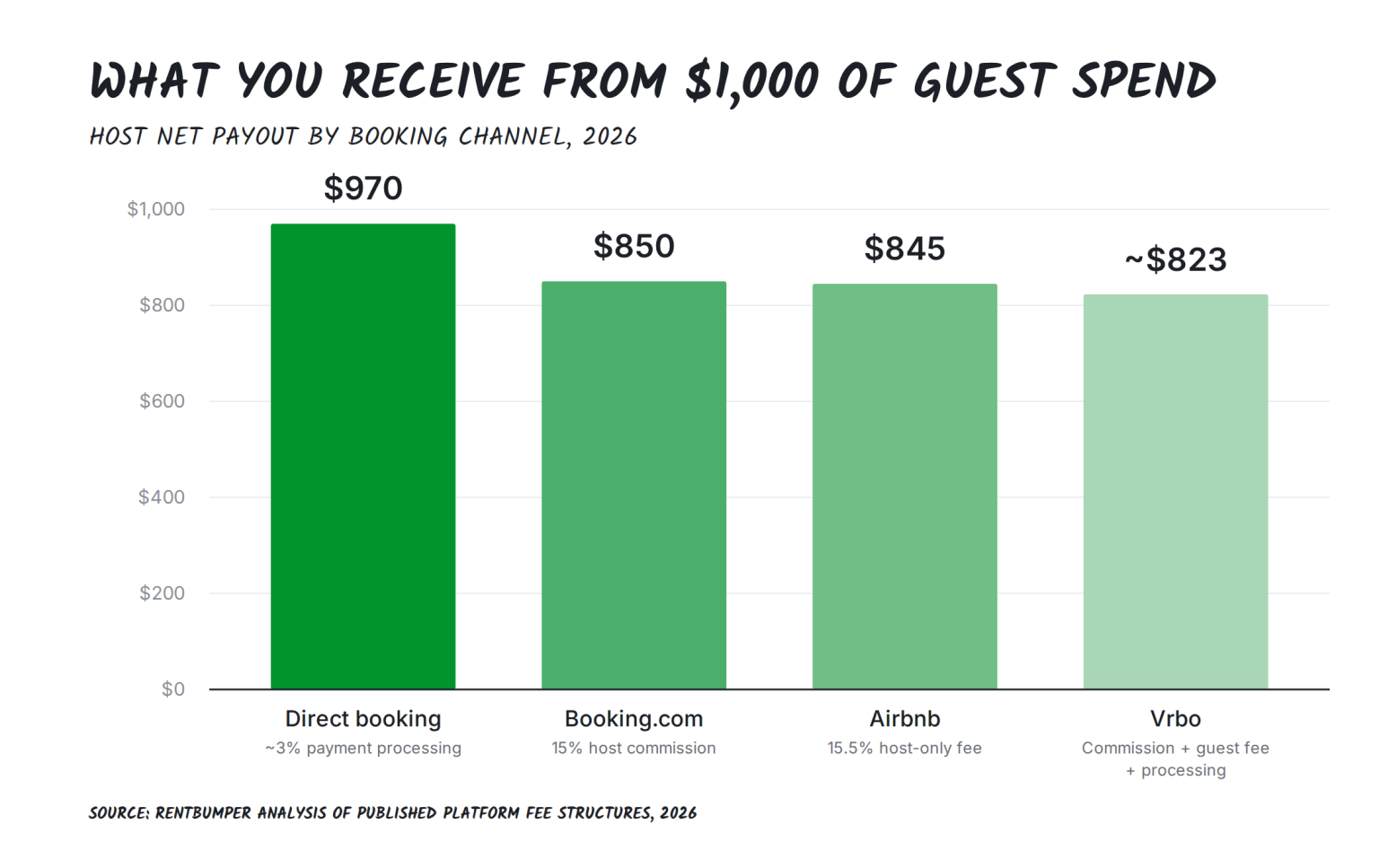
And that’s exactly why “direct booking” has become such a buzz-phrase among hosts these days. Processing your own bookings through Stripe at roughly 3% recaptures the lion share of this OTA leakage, with $970 landing in your bank account from the same $1,000 guest spend. Sounds nice, but of course it’s not so easy to accomplish, especially if you’re just getting started.
Seeking Net-Payout Parity Across Channels
You can’t control OTA fee structures but you can control your pricing architecture. If your goal is net payout parity, defined as equalizing your channel margins so you’re agnostic as to where a booking originates, there are some specific ways to accomplish this feat.
If you’re using dynamic pricing software like PriceLabs, you may not want to deploy uniform base rates across all channels. Instead, use specific mathematically verified channel multipliers. Pushing the same base rate to Airbnb, Vrbo, Booking.com, and your direct booking site will guarantee that some channels yield worse net margins than others.
Setting Your PMS Rate Multipliers
Here’s one framework that can help normalize the leakage and protect your margins across various platforms. If you run on a PMS, you can configure your PMS to push a unique rate to each channel.
- Step 1: The Direct Baseline. Set your Direct Booking rate as your baseline. This is your true market rate without OTA interference. If you need $300 a night to hit your underwriting metrics, $300 is your direct base.
- Step 2: The Airbnb Multiplier. Apply a +18.35% multiplier for Airbnb. This fully offsets the host-only fee without a loss. Don’t use +15.5% as your PMS needs to mark up the baseline by 18.35% so that when Airbnb takes 15.5% off the top, the remaining deposit matches your direct rate.
- Step 3: The Vrbo Multiplier. Apply an +8.7% multiplier for Vrbo. This offsets their 5% host commission plus your ~3% payment processing fee. It normalizes your net payout, but recognize that Vrbo’s guest fees will still make your listing more expensive for the traveler at checkout since their guest fees are quite high.
- Step 4: The Booking.com Multiplier. Apply a +17.65% multiplier for Booking.com, assuming you’re on their standard 15% commission tier. Because Booking.com doesn’t charge a guest fee, this markup will behave similarly to the Airbnb adjustment.
Apply these multipliers across your portfolio and be sure to audit your pass-through fees, including cleaning, pets, etc. to make sure those line items get the same channel markups.
If a potential guest ever reaches out ask why your rates look different across platforms, you can provide a straightforward answer. You’ve simply adjusted your channel pricing to account for for each specific platform’s unique commission structure. Maybe that same guest will be smart enough to sniff around for a direct booking site too!

Written by Devin Redmond
Devin is an independent investor and freelance writer focused on the real estate industry. He previously worked at Jones Lang LaSalle, Hines Interests, and Roofstock. He actively acquires and manages residential properties across California and Hawaii.