Landlord Accounting Software Compared (2026)

When it comes to rental property bookkeeping, many small to medium-sized landlords rank time spent on this essential task right up there with evictions and plumbing repairs. If doing your books is stressful, time-consuming, and your least favorite part of owning rental property, you’re in good company.
And while plenty of competing landlord accounting software options promise to ease the pain, there’s no silver bullet solution. Like most things in life, each platform comes with unique costs and benefits.
In this candid comparison, we unpack key decisions that landlords like you face when evaluating their options. We also break down the core strengths and weaknesses for seven popular platforms: Baselane, Stessa, REI Hub, RentRedi, Landlord Studio, Avail, and Innago.
If you own fewer than 25 doors, you are a key target customer for the platforms discussed below as manual spreadsheets just won’t get it done anymore. Perhaps you also checked out the big players like Appfolio and Buildium, only to quickly discover that high monthly minimums make those platforms too expensive for individual landlords.
Do You Need QuickBooks Instead?
The first decision gate to pass through is whether to use a general ledger like QuickBooks Online (QBO) or a purpose-built real estate accounting platform.
Generally speaking, QuickBooks is built for businesses with inventory, accounts payable, and traditional payroll. It doesn’t understand properties, leases, or tenants natively. To track rentals in QBO, you have to map properties to “Classes” or “Locations,” treat tenants as sub-customers, and manually tag many entries. Miss one tag or set things up incorrectly, and your property-level cash flow reporting and balance sheet accounting will be unreliable.
In our opinion, there are really only two scenarios where QBO’s excessive setup overhead is worth it:
- You operate multi-member LLCs or partnership structures that need formal balance sheets and partner capital account tracking for outside equity partners.
- You run an active, non-rental operating business alongside your properties and want everything consolidated in one place.
If your portfolio consists of disregarded entities and/or straightforward Schedule E rental real estate, we feel that QBO adds a lot of setup hassle for too little payoff. There’s also no native rent collection or tenant screening, and no tenant portal. There’s also just too much chart-of-accounts customization and ongoing management required, which can often trip up anyone without considerable accounting experience.
Why AppFolio and Buildium Are (Probably) Not the Solution
Search results for “landlord accounting software” regularly push enterprise property management platforms like AppFolio and Buildium. These are mostly built for third-party management companies running hundreds (or thousands) of doors for client owners, not owners self-managing 1 to 25 units. They’re big profitable companies so they can afford to stuff Google’s “Sponsored Results” search area with ads, but they are rarely the right call for smaller real estate investors or operators.
AppFolio advertises $1.40/unit/month, but requires a 50-unit minimum to sign up, and charges a $280/month floor regardless of unit count. On a 15-door portfolio, that’s roughly $19/door/month just to access your own books. Buildium starts at $62/month for its entry-level plan, then stacks additional fees on top for things like tenant screening, payment processing, and e-signatures.
For most landlords, complicated trust accounting features, owner disbursement modules, and multi-tier corporate ledgers are features you will never use. So why pay for them?
Four Key Decision Factors for Landlord Accounting Software
Once you rule out general ledgers like Quickbooks and enterprise platforms like Appfolio, we’re left with a selection of purpose-built platforms, each of which deliver different benefits with varying degrees of success. Just because a particular platform offers a particular feature (like maintenance tracking or tenant screening) doesn’t mean they do it particularly well. So set aside the competing feature checklists for a moment and consider four key questions instead.
1. Rent Collection: Built In or Bolted On?
There’s no single “right” answer when it comes to rent collection. You know your tenants better than anyone. Will they gladly pay a small ACH convenience fee every month for the ease of paying online via a tenant portal? Or will they balk and make you swing by in person to pick up an envelope full of cash? Or do you prefer to get paid by check so you can easily refuse partial rent payments if needed? Successful rent collection comes in many flavors!
If your books are decoupled from your rent collection service, you may have some extra data entry or reconciliation to do every month. Tenants paying via Zelle, paper checks, or a separate app may require you to manually match deposits to your bank feed and update tenant ledgers by hand. Maybe it’s worth it or maybe it’s a huge hassle and you’d prefer a single integrated system. Built-in rent collection can record the income seamlessly and automatically mark the rent roll as paid, but it can also introduce a delay in accessing your funds unless you pay for faster clearing times.
The details matter when it comes to rent collection. “Free rent collection” usually means transaction costs are shifted onto your tenant. RentRedi charges tenants a $1.00 ACH fee, Innago charges $2.00. Baselane and Stessa offer $0 ACH collection, but generally require the transaction to run through their landlord banking services, with fees or delays when you route funds to an outside bank.
Either way, choosing a landlord accounting platform will be easier if you can be clear with yourself about how you prefer to handle rent collection.
2. Banking: Move Your Accounts or Sync Them?
Are you willing to move operating (and/or reserve) funds into an integrated landlord banking platform? Baselane in particular has positioned themselves as a “banking-first” option with virtual checking accounts, sub-accounts, and debit cards available on a per entity or per property basis. When you run your vendor charges, Home Depot runs, and other spend related to your rental portfolio through these native bank accounts, the transactions can (in theory) attach to properties and be categorized automatically, thereby saving you hours of manual reconciliation work.
The rub with these fintech banking products is that you’re placing quite a bit of trust in what is a relatively new and somewhat convoluted stack of financial services offerings. Baselane isn’t actually a bank and the accounts are technically provided by Thread Bank via Unit, an intermediary fintech partner. With so many cooks in the kitchen, things can sometimes get a bit confusing from an end user perspective. Same goes for Stessa’s native bank accounts, which are also offered through the same Thread/Unit partner stack.
That said, there are some significant advantages that come with these fintech products, namely that it’s really easy to open multiple business accounts. This can help streamline your operations and reduce accounting errors as you can align bank accounts one per property or one per ownership entity. LLC and partnership accounts are quick and easy to open while traditional banks often struggle to provide business banking without excessive fees, paperwork, and bureaucracy.
If you still prefer to stay with Chase, Wells Fargo, a local credit union, or whoever you currently bank with, you’ll be relying on bank-feed aggregators like Plaid, Yodlee, and MoneyKit to import your transactions into these platforms. This can go very smoothly or very poorly depending on the size of your specific bank, whether they have a national presence or are more regional, and how tightly they choose to control their (your) data. These feeds can disconnect periodically, miss transactions, or generate duplicate entries, all of which leads to inevitable manual review and clean up work.
3. Ledger Depth: Cash Tracker or True Double-Entry?
The third key factor that should weigh heavily among your selection criteria relates to the specific type of accounting provided by the platform. Single-entry platforms are simple cash-in / cash-out tools that offer one line item per transaction. They simply log what you received (income) or spent (expense) as it happens, which is usually enough to populate your Schedule E at year-end. It’s also enough to drive meaningful reporting, including cash flow analyses, throughout the year.
Where the single-entry accounting systems offered by Baselane, Stessa, and others falter is with respect to the balance sheet. They cannot reliably track account balances, asset values, depreciation, owners’ equity, debt liabilities, etc. to the standard expected by most CPAs. But then again, a lot of CPAs track this stuff on behalf of their real estate clients, so maybe you don’t care to deal with it personally. But it’s something to know and understand before you decide what type of accounting system you need.
If you want to track liability balances, mortgage principal reduction, or depreciation on specific capital improvements, you may need a double-entry system like the one offered by REI Hub (or even Quickbooks). Many owners with larger portfolios and/or multiple equity partners ultimately decide they need a true double-entry system, unless they prefer to have their CPA handle the balance sheet aspects.
If you have any doubt how complicated depreciation tracking can get, check out our MACRS depreciation calculator for a taste of how it works.
4. Asset Mix: Just Long-Term or LTR/STR/Mid-Term?
The lease duration mix of your portfolio is the fourth major factor to consider when evaluating landlord accounting software. The extent to which the platforms evaluated here support short-term rentals varies greatly and none of them was designed with anything but long-term rental as the primary use case. Since mid-term rentals behave much more like long-term rentals than vacation rentals, these platforms generally handle mid-terms just fine. But if you’re operating short-term rentals, you will almost certainly find something lacking in each of these accounting solutions.
In their defense, the OTAs aren’t exactly organized when it comes to reporting your short-term rental income and expenses. Airbnb, VRBO, and Booking.com all refuse to abide by anything resembling an industry standard when it comes to their CSV and PDF formatting. Sometimes they pay out net figures after withholding host fees and occupancy taxes while in other cases, they report top line gross figures alongside deductions for commissions, refunds, and other holdbacks. AI tools can certainly help break down these documents and generate useful line items, but in our opinion, the platforms reviewed here aren’t yet able to ingest these outputs smoothly.
So if you own and operate short-term rentals, expect to spend a decent amount of time in your chosen platform each month making sure your income and expenses are being handled properly. You’ll also want to keep your expectations in check when it comes to performance tracking. These platforms don’t natively support concepts like short-term occupancy, revenue per available room, average nightly rate, or other key vacation rental operations metrics.
REI Hub probably handles short-term rental activity better than any of the other platforms, which means RentRedi is also a viable option with the REI Hub add-on. Baselane and Stessa both offer limited support for vacation rentals, but manual workarounds are required as neither one has a native upload feature for files downloaded from the major OTAs. Landlord Studio, Avail, and Innago don’t appear to offer any native STR features or support.
7 Landlord Accounting Platforms Compared
| Platform | Ledger Depth | Native Rent Collection | Banking Setup | STR Features | Pricing (12-Month) |
|---|---|---|---|---|---|
| Baselane | Single-entry cash flow | Yes ($0 ACH w/ banking) | Integrated banking | Limited | Free $20/mo |
| Stessa | Single-entry cash flow | Yes ($0 ACH w/ banking) | Integrated banking | Limited | Free $12/mo $28/mo |
| REI Hub | True double-entry | No (pure accounting) | External bank feeds | Native STR support | $9–48/mo (by # units) |
| RentRedi | Single-entry (double via REI Hub) | Yes ($1 tenant ACH) | External bank feeds | Relies on REI Hub add-on | $12/mo |
| Landlord Studio | Single-entry cash flow | Yes ($2.50 ACH fee) | External bank feeds | LTR-focused | Free $12+/mo $24+/mo |
| Avail | Single-entry cash flow | Yes (via Realtor.com) | External bank feeds | LTR-focused | Free $9/mo/unit |
| Innago | Single-entry cash flow | Yes ($2.00 tenant ACH fee) | External bank feeds | LTR-focused | Free |
Baselane: The Banking-First Automator
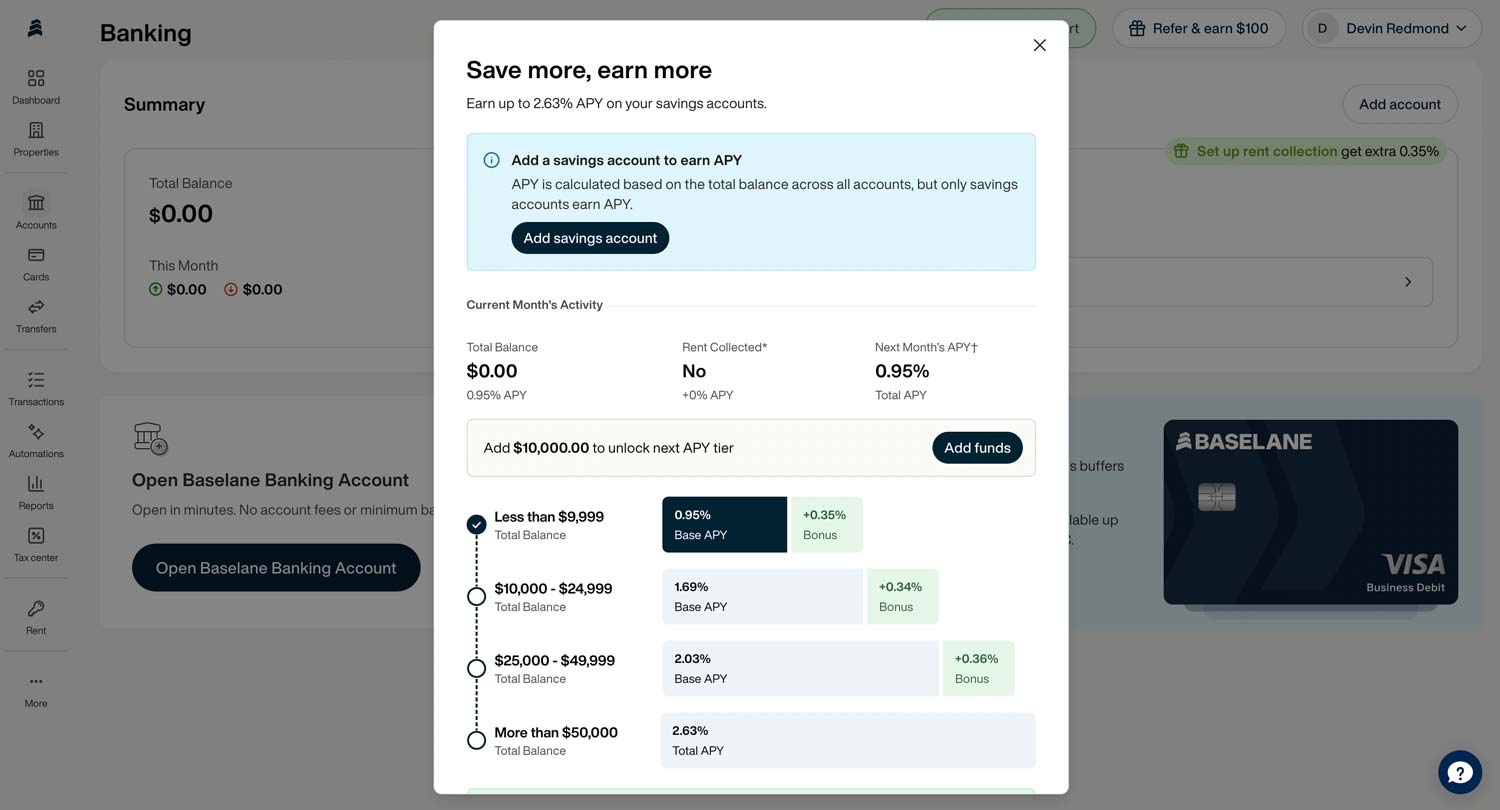
Baselane’s core differentiator is their native banking offerings, including unlimited checking and savings accounts, rent collection service, automated money movement, and auto-tagging for transactions (paid accounts only). If you’re frustrated with your current bank and looking for a more organized and integrated banking solution for your rentals, Baselane deserves a serious look.
You can open separate virtual checking accounts and debit cards for each property, and (on the paid tier) the software will use AI and custom rules to auto-tag each income and expense transaction to your Schedule E buckets in real-time. You can also connect external financial accounts and import your data, but the auto-tagging is less reliable with this method and you will inevitably incur some amount of manual work to clean things up. In our opinion, Baselane is best suited for investors with multiple properties that aren’t too particular about their banking relationships and want to streamline their transaction categorization, financial reporting, and tax prep process.
The tradeoffs are pretty clear with Baselane. While they are laser-focused on helping you run your rental property finances more efficiently, they are clearly less committed to developing operational features like maintenance tracking and tenant communications. And while you can certainly get a lot out of Baselane without signing up for their native banking program, expect to hear about it frequently until you relent as it’s foundational to how the platform delivers value and drives paid subscriptions.
Either way, you do need a paid account to enjoy most of Baselane’s best features, including faster rent deposits, transaction auto-tagging, custom tagging rules, custom categories, balance sheet reports, and priority support, among other bells and whistles.
Stessa: Easy Bookkeeping & Reporting
Stessa, probably more than the others on this list, has tried to position itself as everything you need to “buy, sell, and manage” rental properties. That’s a tall order and encompasses the entire investment lifecycle. To what extent it succeeds in covering all the bases is most certainly up for debate.
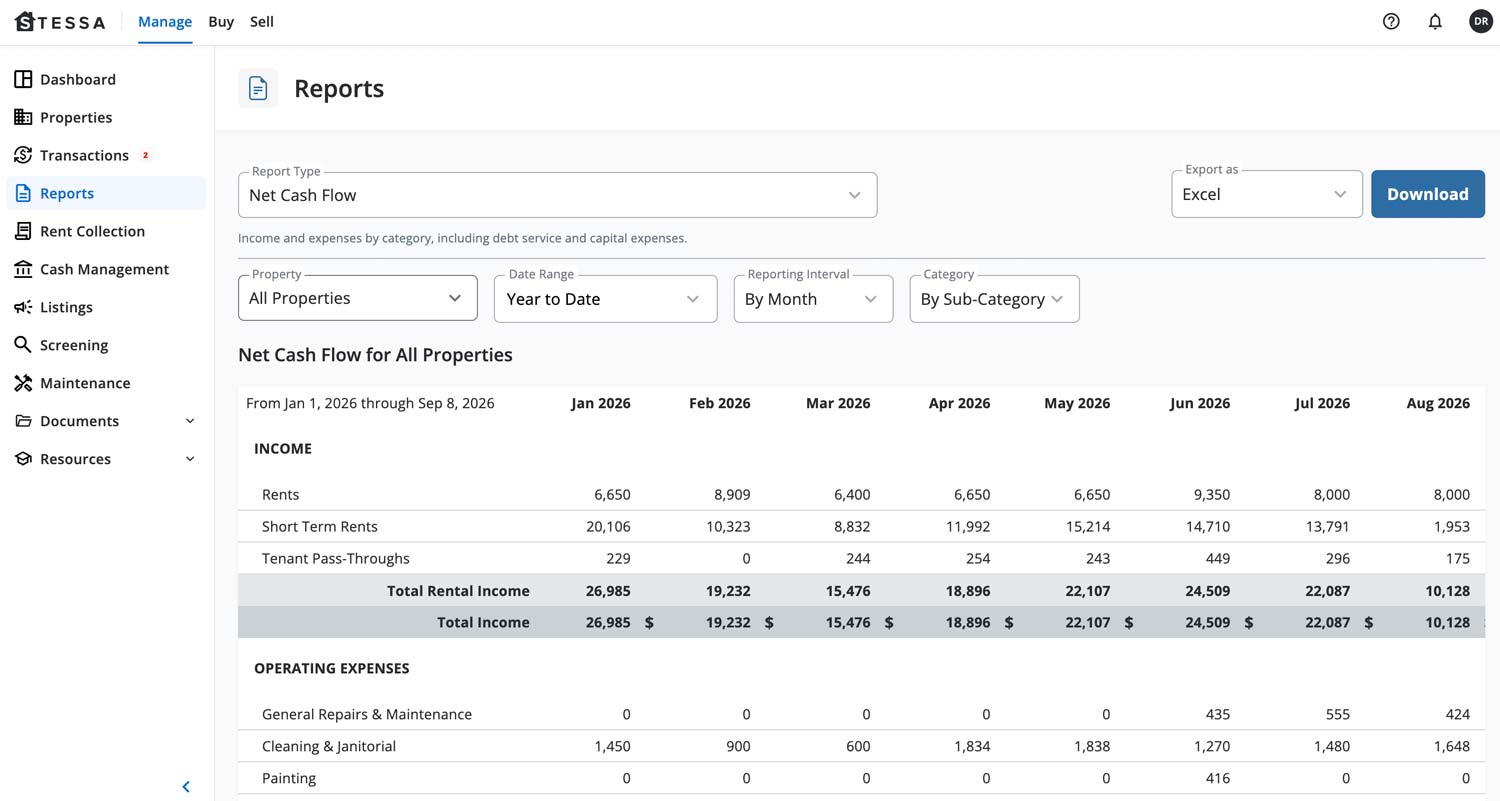
The platform built its reputation around bookkeeping and the evidence of that origin story is clear from the moment you onboard. The online experience strongly encourages investors to establish data connections to external bank, credit card, and mortgage accounts so Stessa can automatically categorize transactions and build comprehensive financial reports. This is Stessa’s most obvious benefit and where the platform distinguishes itself from the competition. While the bank feeds do break from time to time and the categorization engine isn’t 100% accurate, a few manual corrections will usually produce highly accurate and robust cash flow reporting (even on the Free plan). Schedule E reports are also available to help you and/or your CPA get ready for tax time, but only on the paid plans.
In recent years, Stessa has launched a slew of new features including native bank accounts (similar to Baselane), rent collection, tenant screening, maintenance requests, e-signatures, legal documents and forms, and even a marketplace to buy and sell investment properties. These are ambitious undertakings and some of these newer features can feel a bit unpolished at times. We would love to see a renewed focus on the core accounting features, particularly related to using embedded AI to more seamlessly categorize transactions and surface personalized insights using data sourced across Stessa’s entire platform.
One thing we’re sure of is that Stessa’s reporting features continue to be clear winners. Even with the free plan, you can import an unlimited number of transactions, categorize them swiftly and easily, and then run professional looking cash flow reports at the press of a button. That ease of use is a function of Stessa’s decision early on to prioritize single-entry accounting, which as we discussed earlier has its pros and cons. Balance sheet reporting clearly suffers as a result and the platform does not track depreciation in any meaningful way. But Stessa also offers some well-designed visual dashboards that operate at both the property and portfolio level, and you can even set up multiple portfolios (on the Pro plan).
Finally, while Stessa offers the ability to designate a property as a short-term rental, this toggle only delivers certain specific benefits to vacation rental operators. The dashboards and reporting don’t really change much and you don’t suddenly gain visibility into key metrics like occupancy or average nightly rates. You are able to input some assumptions and make STR specific projections but the software still uses imprecise terms like “lease” and asks you to enter “tenant” names, which don’t really make sense for a vacation rental. But if you’re an STR owner mostly looking to track income and expenses, run cash flow reports, and prep for tax time, Stessa remains a strong contender.
REI Hub: The Real Estate Double-Entry Specialist
REI Hub is a purpose-built double-entry accounting engine for real estate, pre-configured with appropriate accounts, property classes, fixed asset schedules, and Schedule E tax mapping. They are increasingly focused on serving short-term rental investors and offer features designed to support mixed portfolios across long, short, and medium-term rental activities. In our view, it’s quite capable with mixed LTR/STR portfolios and gets a lot of the details right, like separating gross booking revenue from platform fees and lodging taxes.
If you feel stuck between Quickbooks’ steep learning curve and less flexible single-entry accounting platforms, REI Hub may offer something of a happy medium. REI Hub tracks mortgage liabilities, amortizing loan balances, and accumulated depreciation across individual LLCs and can also roll up to a consolidated portfolio view. There’s a “chart of accounts” and CPAs seem to appreciate that the platform is rooted in core accounting principles. You can even produce a true balance sheet, once you’ve mastered the set up.
And that’s where some investors get frustrated. REI Hub does typically require more upfront time and energy than the other platforms reviewed here. User reviews repeatedly describe REI Hub as “feature rich” to the point of feeling complex on first use, and more than one reviewer flagged friction connecting and editing bank transactions. If REI Hub will be your first experience with an accounting platform, budget some time and patience to get comfortable with how it all works. Do not expect a quick 15-minute ramp up. REI Hub is just built differently than the other accounting solutions on this list.
One big caveat worth noting is that REI Hub was always accounting only, with no native rent collection, tenant screening, or leasing tools. They had a long-running partnership with TurboTenant, which then acquired REI Hub in late-2024. As of September 2026, you can still sign up for REI Hub on a stand-alone basis, but we’re not sure how long that will continue to be the case. Even prior to the acquisition, some customers described the two as functioning “almost like one system.” Rent collection services in particular are accessible through TurboTenant’s platform and can flow straight into REI Hub’s books if that’s what you want.
REI Hub has also historically played nicely with another competing platform, RentRedi, and they have publicly said they will continue to support that integration. But RentRedi also now offers a single-entry native bookkeeping solution as an alternative to the premium REI Hub upgrade.
In our opinion, REI Hub is now essentially a package deal with TurboTenant and the acquisition raises a fair question about how long REI Hub will stay platform-agnostic. It may be risky to assume you will be able to indefinitely continue using REI Hub alongside Baselane, Stessa, Landlord Studio, Avail, or Innago.
RentRedi: The Flat-Fee Portfolio Scaler
RentRedi has always been heavily focused on day-to-day operational needs, rather than landlord accounting. It takes the concept of flat-rate pricing to an extreme, charging only $12/mo regardless of whether you have 1 or 100 units loaded up on the platform. The assumption here is that the more units you bring onto the system, the more revenue-generating activity you’ll participate in through offerings like rent collection and tenant screening.
For an owner with big plans to scale up, the flat annual rate can be very appealing. Imagine averaging that cost all the way down to $0.50/mo per unit once your portfolio grows to 24 doors. But keep in mind that cost does not account for the REI Hub add-on you’ll need if you want to turn RentRedi into a double-entry landlord accounting solution. That bookkeeping module comes with an added monthly cost that currently varies based on the size of your portfolio.
Previously, if you were looking for strong operational support and robust double-entry accounting, you could have done quite well with the RentRedi / REI Hub combo meal. With TurboTenant’s acquisition of REI Hub, the value proposition changes significantly as the future of the integration becomes less certain. RentRedi and TurboTenant are direct competitors so you may want to consider whether RentRedi’s operational strengths and pricing structure are compelling enough to justify adopting their new and untested single-entry accounting features.
Landlord Studio: Automated Bookkeeping for a Price
We find Landlord Studio a bit challenging to decipher. On the one hand, their marketing pitch, “easier to use and cheaper than QuickBooks,” is focused on accounting, but their free intro plan is operationally heavy with no compelling bookkeeping features. That means you have to step up to the paid “Pro” plan (currently $12/mo) to even begin to evaluate the core offering, including automated bank feeds, a Xero-accounting integration, and financial reports.
Once you make that leap to a paid tier, you’ll see that Landlord Studio has followed a very similar playbook as Stessa. Simplified single-entry bookkeeping remains the heart of the platform with an emphasis on auto-categorization of income and expenses, Schedule E tax reporting, and adjacent offerings like mobile receipt scanning and mileage tracking. While additional revenue-generating features like rent collection and tenant screening have been introduced more recently and are available on the free “Go” plan, these are not distinctly different from the versions offered by other competitors on this list.
The Pro plan runs $12/mo for up to 3 units (+$1/unit thereafter) and allows up to 5 bank feeds and 25 automated transaction rules. That’s roughly $34/mo at 25 doors, which is more than flat-fee competitors like RentRedi but modest in absolute terms. Online rent collection carries its own ACH fee and deposits can take 5–7 days to land in your account, which is slower than the fast-funding options some competitors advertise.
There’s also a Pro Plus plan, which currently adds another $12/mo regardless of unit count. That plan allows up to 20 bank feeds and 250 automated transaction rules, which can be a big time-saver across larger portfolios. The custom rules also offer a compelling point of differentiation with Stessa, which has not yet introduced the ability to write your own categorization rules for data sourced from automated bank feeds.
Avail: The Leasing-Centric Platform
Backed by Realtor.com, Avail approaches landlord software from the tenant-acquisition side first, prioritizing listing syndication, background checks, and state-specific digital lease templates. This focus is somewhat unique and, in our opinion, appeals to a specific type of newbie landlord that may be confused or intimidated by the process of finding and vetting high quality tenants. These core leasing features are available on the free plan for an unlimited number of units, which makes sense given that leasing activity (and follow-on rent collection) typically generates significant revenue from the tenant side of the equation.
Avail does also offer a single paid plan, currently priced at $9/mo per unit. This can get very steep for larger portfolios, which only serves to reinforce how focused they are on more casual one-off landlords. This paid plan remains very operationally focused, with offerings centered around marketing upgrades, quicker rent deposits, waived ACH charges, and customizable lease templates.
Where Avail appears to fall significantly short of its competition is in the area of landlord accounting, bookkeeping, and reporting. The platform offers only a basic spreadsheet exporter, no automated bank feeds, no Xero-style integration, no double-entry option, and no Schedule E export. While some accidental landlords with only 1-2 properties may find that Avail’s manual data entry and very basic reporting is sufficient, most serious landlords will need to supplement with Quickbooks, REI Hub, or another standalone bookkeeping solution.
Innago: The Zero-Subscription Cost Tool
Innago charges owners nothing, regardless of portfolio size and offers access to digital leasing, screening, maintenance requests, and rent collection from day one, whether you have one unit or a thousand. The platform monetizes entirely through the tenant side, via mechanisms like ACH fees, credit card processing fees, and tenant screening/credit reports.
This “free for landlords, not for tenants” approach is not unusual among landlord accounting software but we generally prefer a more balanced approach. The risk here is that over time, Innago’s product managers and software engineers may be forced to make too many tough decisions about whether to spend limited resources developing new features for landlords or focusing on revenue-generating features for tenants. Doing both well at the same time can be a lot harder than it seems!
It comes as no surprise then, that Innago does not offer live bank feeds to bring in outside transactions and delivers only minimal reporting and tax features. If you intend to use Innago for actual bookkeeping, prepare yourself for a lot of manual work creating and classifying transactions. Also know that advanced balance sheet and cash flow reporting is simply not supported on the platform in any meaningful way.
Similar to Avail, we think Innago is most appropriate for smaller landlords who are just getting started and want to accomplish key leasing activities at the absolute minimal cost. Innago may also be a good choice for landlords with very diverse portfolios that include student housing, self storage, commercial assets, parking, salons, and/or other more exotic types of real estate investments. Innago has made a conscious decision to keep their platform flexible and somewhat generic so that it can serve a very wide cross-section of investors.
Which Landlord Platform Best Fits Your Portfolio?
- Baselane may be the strongest choice if you’re looking to integrate banking and property-level bookkeeping all in one place.
- Stessa could be the right call if you’ve already hired a PM but still want to accurately track your overall financial picture without touching a spreadsheet.
- REI Hub is probably best if you absolutely must have real double-entry accounting and want something built specifically for real estate.
- RentRedi might the best choice for landlords seeking primarily operational help, specifically with tenant screening, rent collection, and maintenance tracking.
- Landlord Studio is worth considering if you want to keep things simple and don’t mind paying for time-saving automated bookkeeping features.
- Avail could be your best bet if you’re new to landlord software and want to streamline your leasing and rent collection while your CPA handles the numbers.
- Innago might be right for smaller landlords looking for a no-cost option that’s almost exclusively focused on leasing and operational tasks.
Landlord Accounting Software FAQ
Baselane, Stessa, and Innago all offer genuinely usable free tiers, not just crippled trials. Baselane’s free tier is the most feature-complete if you’re willing to route banking through their platform. Stessa’s free Essentials tier gives you unlimited transaction imports and solid cash flow reporting, though Schedule E reports require a paid plan. Innago is free indefinitely regardless of portfolio size, but monetizes through tenant-paid fees instead. Which is “best” depends on whether you want banking-first (Baselane), reporting-first (Stessa), or operations-first (Innago).
Yes, particularly if you want clean, automated cash flow reporting without touching a spreadsheet. Even non-paying users can import unlimited transactions and generate professional-looking reports. Its main limitations are single-entry accounting (no real asset basis or depreciation tracking) and occasional bank feed sync issues that show up repeatedly in user reviews. It’s a strong fit for owners who’ve already delegated day-to-day management and just want an accurate financial picture.
For 1–2 units, a free tier from Baselane, Stessa, or Avail may cover much of what you need without a monthly subscription fee. The math changes once your portfolio grows or includes short-term rentals. That’s when manual reconciliation starts eating into your evenings and is typically the moment when paying for automated bank feeds and per-property tagging (Baselane, Stessa Pro, or Landlord Studio) starts to make sense.
You can, and plenty of landlords do this successfully with 1–2 properties. The wheels tend to come off around 3+ properties, when reconciling bank transactions by hand, tracking depreciation, and keeping each property’s P&L separate becomes too confusing and time consuming. If you’re not there yet, a well-built spreadsheet is a completely reasonable starting point, even if most landlords eventually migrate to a more feature-rich software solution.
There isn’t one single best solution for all landlords and this is the wrong question to start with. Instead, ask yourself how you want to collect rent, whether you’re willing to move your banking onto a fintech platform, whether you need real double-entry accounting, and whether you’re running short-term rentals. Answer those first, and the best platform for your particular situation will become obvious.
Yes, it’s meaningfully different. QuickBooks and similar general ledgers don’t natively understand properties, leases, or tenants. You have to manually build that structure yourself using Classes or Locations, which takes real setup time and is easy to get wrong. Most purpose-built landlord platforms come pre-configured with property-level tracking and Schedule E mapping out of the box, which is why most landlords with straightforward portfolios find them easier to manage than QuickBooks.

Written by Devin Redmond
Devin is an independent investor and freelance writer focused on the real estate industry. He previously worked at Jones Lang LaSalle, Hines Interests, and Roofstock. He actively acquires and manages residential properties across California and Hawaii.